
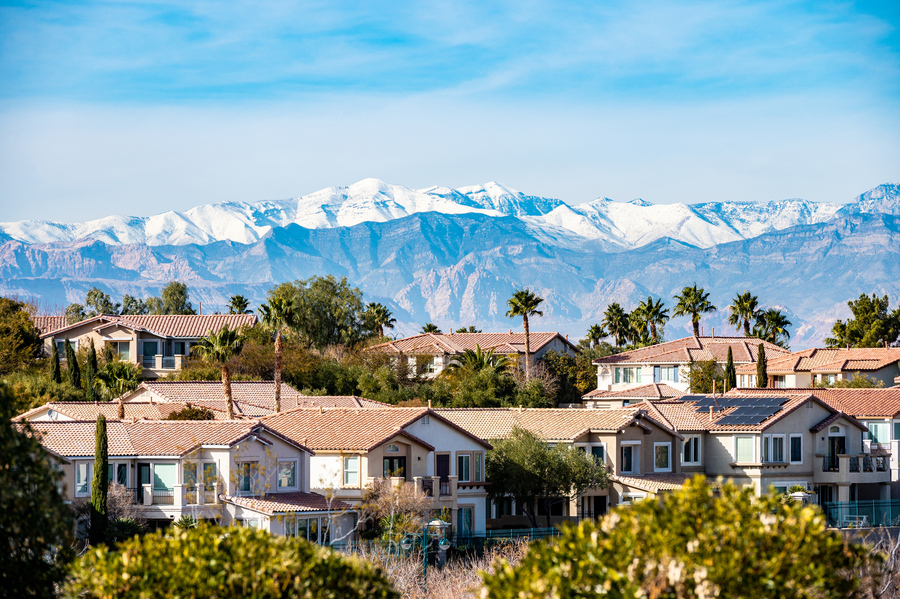
Residential neighborhoods in Mountain’s Edge sit close to parks, trails, and desert landscapes.
Mountain’s Edge is one of southwest Las Vegas’ better-known master-planned communities, in part because it offers something buyers don’t always find in newer developments: an established neighborhood with more than 12,500 residences, extensive parks and trails, and a wide range of housing built over the past two decades.
Spread across roughly 3,500 acres, it also puts residents close to the shopping and dining along Blue Diamond Road and the 215 Beltway.
If you’re thinking about buying a home for sale in Mountain’s Edge, Las Vegas NV, here are the details worth knowing before you start touring.
Table of Contents:
- Mountain’s Edge puts much of Las Vegas within easy reach
- Mountain’s Edge offers newer housing across a wide range of styles
- Outdoor recreation is built into Mountain’s Edge
- Commercial establishments are concentrated along Blue Diamond Road
- HOA costs can vary from one neighborhood to another
- Features worth comparing from one Mountain’s Edge home to another
- FAQs about buying a home in Mountain’s Edge
- Ready to explore the homes in Mountain’s Edge, Las Vegas?
Mountain’s Edge puts much of Las Vegas within easy reach
Located in southwest Las Vegas near Blue Diamond Road and the 215 Beltway, Mountain’s Edge residents have several major areas of the valley within a 20- to 25-minute drive during lighter traffic.
The community has relatively straightforward access to the Strip, Harry Reid International Airport, Summerlin, and other parts of the valley.
Blue Diamond Road is the community’s main east-west corridor, while Durango Drive, Buffalo Drive, and Rainbow Boulevard provide additional routes through the southwest valley. The 215 also makes it easier to reach destinations farther north or east without relying entirely on surface streets.
The practical advantage from a buyer’s POV: Having a residential setting while still staying close to many everyday needs. Grocery stores, restaurants, medical offices, gyms, and home improvement stores are concentrated along Blue Diamond Road and near the 215, so many regular errands can be handled within the surrounding southwest Las Vegas area.
Mountain’s Edge offers newer housing across a wide range of styles
Development in Mountain’s Edge began in 2004, so much of the housing stock is newer than what buyers will find in many older Southwest Las Vegas homes. The community now includes more than 12,500 residences, with options ranging from townhomes and smaller single-family homes to gated neighborhoods and larger semi-custom properties.
Different subdivisions offer different housing options
Housing varies noticeably from one subdivision to another. Chaco Canyon, for example, includes homes ranging from roughly 1,500 to 3,800 square feet, while Tularosa is known for single-story homes of up to about 2,100 square feet. Azure Canyon includes larger three-story designs approaching 3,300 square feet, while Beacon Hill offers a gated townhome setting.
Home prices reflect that range
According to Realtor.com, Mountain’s Edge had a median listing price of about $525,000 in September 2026, while the median sold price was about $410,000. The median price per square foot was $232.
Townhomes and smaller resale properties tend to sit toward the more accessible end of the market, while larger single-family homes can move well above the community median. Pools, larger lots, extensive renovations, gated locations, and additional square footage can all push prices higher.
Resale homes make up most of the market
Although Mountain’s Edge began developing in the mid-2000s, it’s now largely an established community. Most available homes are resales, while new construction is more limited and tends to be concentrated in newer sections in and around the area.
That can work in a buyer’s favor. Resale homes may already include features that would otherwise need to be added after closing, such as finished landscaping, covered patios, pools, window coverings, or other owner upgrades.
Outdoor recreation is built into Mountain’s Edge
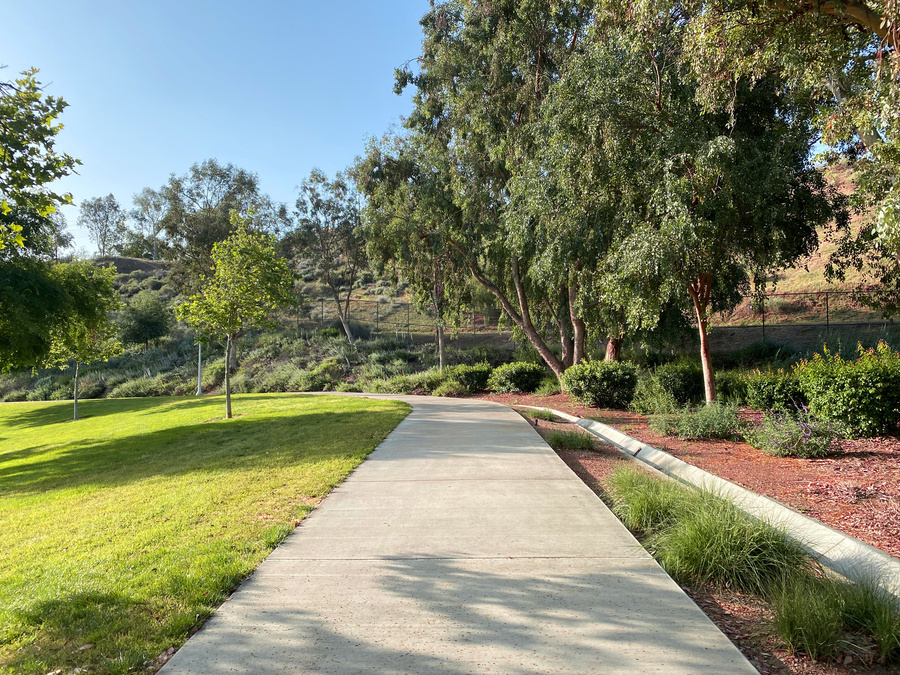
Outdoor spaces throughout Mountain’s Edge include parks, trails, and neighborhood paseos.
Mountain’s Edge was planned with parks, walking trails, and paseos woven throughout the neighborhood, so residents don’t have to rely on a single recreation area. That said, there are three main community parks nearby, namely:
- Exploration Peak is the standout, with roughly 80 acres, walking paths, playgrounds, picnic areas, pickleball courts, a splash pad, and trails leading up the peak.
- Nathaniel Jones Park is more neighborhood-focused, with a playground, splash pad, and dog park, while Paiute Park adds basketball and sand volleyball courts.
- Mountain’s Edge Regional Park is outside the master association and operated separately by Clark County. It expands the recreation options with sports fields, baseball facilities, racquetball courts, a children’s bike-safety area, and outdoor climbing features.
Commercial establishments are concentrated along Blue Diamond Road
Most shopping, dining, and everyday errands in Mountain’s Edge are concentrated along Blue Diamond Road and the 215 corridor. One of the main commercial hubs is Mountain’s Edge Marketplace at Blue Diamond Road and Buffalo Drive.
Nearby establishments include:
- Albertsons
- Ross Dress for Less
- Planet Fitness
- Starbucks
- Chase Bank
- T-Mobile
- The UPS Store
- Medical and dental offices
Meanwhile, below is a snapshot of nearby dining options around Mountain’s Edge, with options ranging from casual breakfast spots and neighborhood pubs to Italian and seafood restaurants.
- Mountain West Eatery – casual breakfast and American comfort food along Blue Diamond Road.
- Locale Italian Kitchen – Italian dishes, house-made pasta, steaks, and craft cocktails on Blue Diamond Road.
- CAJUN CRUSH – seafood boils and Cajun-style dishes on Blue Diamond Road.
- Village Pub Mountains Edge – casual American pub fare on South Rainbow Boulevard.
- Salt & Spoon – Modern American dishes and brunch nearby.
- Sgrizzi Ristorante & Bar by Chef Marc – Italian dining and steakhouse fare on South Rainbow Boulevard.
HOA costs can vary from one neighborhood to another
Every home in Mountain’s Edge is part of the master association, which maintains community parks, landscaping, common areas, and other shared spaces. For 2026, the master association assessment is $135 per quarter.
Some neighborhoods also have their own sub-association, which can add another monthly fee and another set of rules. That’s where the difference between two nearby properties can become more noticeable. For example, listings in Beacon Hill at Mountain’s Edge have recently shown HOA fees around $148 per month, while some single-family homes in Chaco Canyon have shown lower monthly HOA amounts.
Depending on the property, association documents may cover:
- Monthly or quarterly assessments
- CC&Rs
- Architectural guidelines
- Landscaping standards
- Parking rules
- Rental restrictions
- Neighborhood-specific fees
Exterior changes such as paint, fencing, or landscaping may also require architectural approval. The exact rules depend on the property and any additional association tied to it.
Features worth comparing from one Mountain’s Edge home to another
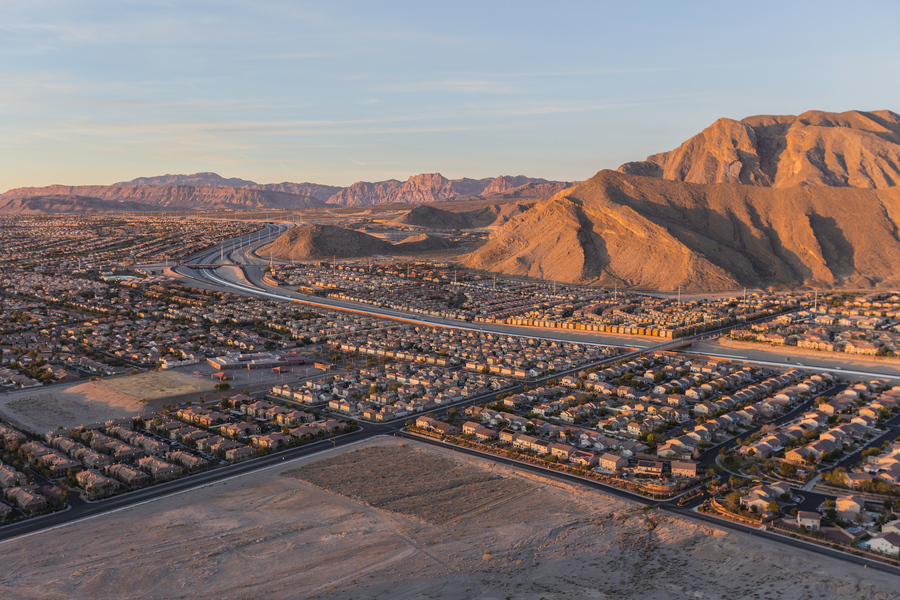
Homes in southwest Las Vegas sit against the open desert and mountain landscape.
When you’re going through your options in Mountain’s Edge, these are the key home characteristics worth comparing.
- Backyard setup: Pools, covered patios, turf, built-in grills, and finished landscaping can save you from taking on major outdoor projects after closing.
- Sun exposure: In Las Vegas, the direction of the backyard and main living areas can make a noticeable difference in afternoon heat, especially during summer.
- Single-story vs. multi-story living: Mountain’s Edge has both, so buyers can compare the convenience of one-story layouts with the extra separation and square footage often found in two- and three-story homes.
- Garage and storage: Three-car garages, tandem spaces, side-yard access, and additional storage aren’t available in every subdivision or floor plan.
- Pools and other major upgrades: A home with a pool, updated kitchen, newer flooring, or renovated bathrooms may carry a higher price, but it can also mean fewer projects after closing.
- HOA structure: Some homes are subject only to the master association, while others may also have a neighborhood-level association with additional fees and rules.
FAQs about buying a home in Mountain’s Edge
Is Mountain’s Edge a good fit for buyers who want newer homes?
It can be. Much of Mountain’s Edge was developed from the mid-2000s onward, so buyers will find plenty of relatively modern resale homes alongside a smaller amount of newer construction. Floor plans, lot sizes, finishes, and HOA structures can still vary quite a bit from one subdivision to another.
Are there gated neighborhoods in Mountain’s Edge?
Yes. Some subdivisions within Mountain’s Edge are gated, while others aren’t. Buyers who prefer a gated setting should confirm the setup for the specific neighborhood they’re considering, along with any additional HOA fees or rules that may come with it.
Do homes in Mountain’s Edge commonly have pools?
Pools are available, but they aren’t standard across the community. Some resale homes already have private pools and finished outdoor spaces, while others have simpler yards or no pool at all. That can make a meaningful difference in both price and the amount of work you’ll want to take on after closing.
Ready to explore the homes in Mountain’s Edge, Las Vegas?
Mountain’s Edge gives buyers plenty to compare, from gated neighborhoods and townhomes to larger single-family homes with pools, upgraded outdoor spaces, and different HOA structures. Once you know which features matter most to you, it’s much easier to narrow the home search.
I help buyers eyeing Las Vegas find the home that fits their lifestyle. Let me do the same for you.
Make your home search in Las Vegas easy. Call me at 702.419.3212 or send me an email to get started.